
By Dr. Aidan Manning, New Mexico Wild Rivers & Waters Program Associate
When we talk about rivers in New Mexico, it’s no surprise that many people think first of the Rio Grande. More than 1.2 million New Mexicans (over half our state’s population) live within the boundaries of its watershed, which is the largest major drainage basin in the state. The Rio’s unique habitats, traditions, and economies are threatened by a complex knot of dire and interconnected challenges. For those who work to protect and steward the Rio Grande watershed, these challenges could easily occupy a lifetime of work.
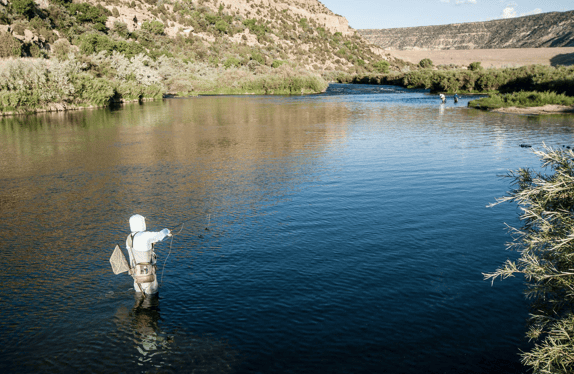
It’s a lot to ask that we also keep track of the massively embattled Colorado River Basin, but our legal and hydrologic realities necessitate that we do precisely that. New Mexico, along with six other states, two countries, and over 30 Tribal sovereigns are currently locked in a tortuous negotiation process, in which we must find a way to share the increasingly strained Colorado River. These negotiations took center stage at a recent two-day conference in Boulder, Colorado, where experts and stakeholders from across the basin gathered to discuss the current state of the River and the future of its management. Ideas and opinions ranged from obstinately shortsighted to boldly progressive, but the underlying message was clear: the decisions we make now about how to share and protect the Colorado River will have far-reaching effects on the region’s people and ecosystems for decades to come.
Compared to California, Colorado, and Arizona, New Mexico is a smaller player in the Colorado River Basin. Only about 3% of the Basin’s 40 million water users live in New Mexico, and we hold rights to a similarly small proportion of the Colorado River’s legally allocated flows. Nonetheless, our portions of the Colorado River represent incredibly important water sources in our dry state. The Gila and San Juan rivers, both major tributaries to the Colorado, host remarkable biodiversity, aquatic and riparian ecosystems, active farmlands, and flourishing recreation economies. Residents of Farmington, Shiprock, Silver City, and many other communities rely on them for drinking water and other municipal uses. What many people don’t know is that Colorado River water also plays a major role in the water budget of the Middle Rio Grande.
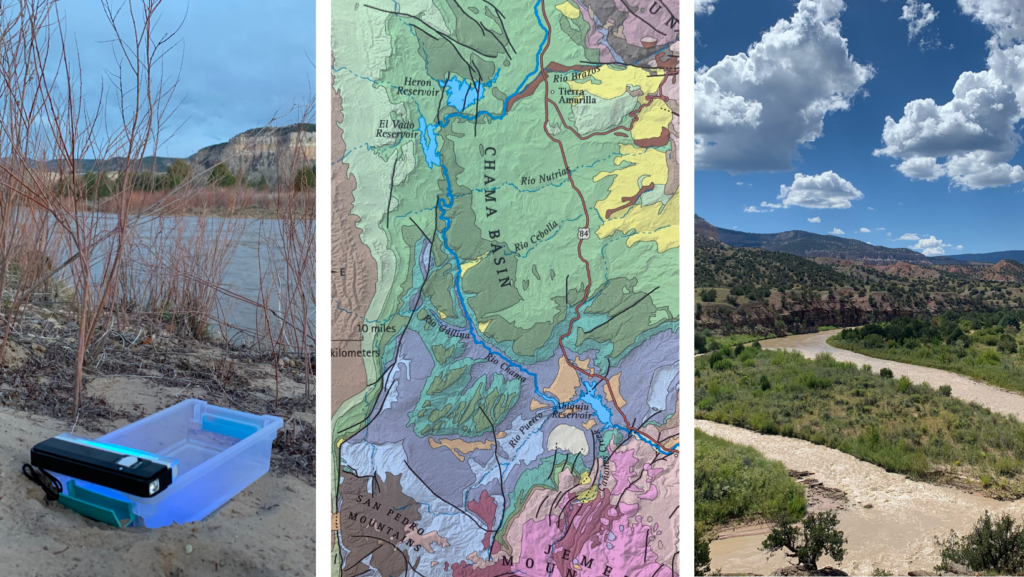
Most of New Mexico’s share of the Colorado River is diverted from high elevation tributaries in the San Juan River watershed and carried across the Continental Divide to the Rio Chama watershed by a series of tunnels. Collectively, these diversions and tunnels make up the Bureau of Reclamation’s San Juan-Chama Project (or SJCP). By measuring both incoming SJCP water flows and “native” flows in the Chama and Rio Grande, the SJCP water can be tracked and managed separately from other waters in the Rio Grande watershed. This separate management frees SJCP water from many of the constraints imposed by the Rio Grande Compact. For water users in the Middle Valley, the resulting flexibility makes SJCP water particularly valuable.
Before the San Juan Chama Project’s completion in 2008, the City of Albuquerque relied entirely on unsustainable groundwater pumping for its drinking water. SJCP water, which is transported by and drawn from the Rio Grande channel, now replaces much of that pumping and helps stabilize our aquifer. Similarly, the imported Colorado River water supplements the Middle Rio Grande Conservancy District, which delivers water to 11,000 irrigators and six Pueblos. Wildlife and habitats also benefit from supplemental instream flows (aka environmental flows), which help keep our increasingly dry river a little wetter for a little longer thanks to several novel partnerships and agreements using the flexible SJCP water.
Increased strain and uncertainty in the Colorado River Basin means that the water we’ve come to depend on is becoming less reliable. Many users of SJCP water are expecting to receive less than a third of their usual allocation this year, mirroring shortages of the Rio Grande’s own native flows. As a result, farmers are struggling to irrigate crops, more stretches of the river are drying, ecosystems and wildlife are precariously stressed, and cities and towns are having to pump more groundwater. The uncertainty created by unresolved Colorado River negotiations only magnifies the problems created by our drying rivers. We know that we need to find ways to use less water, that much is a given, but it is difficult to develop fair and well-informed solutions when we don’t know how the chips will land for the portion of our water coming from the Colorado River. The longer it takes to form foundational interstate agreements, the harder it becomes to move towards long term solutions at the state and local level, and the worse the condition of our rivers will get.