
By Jerry O’Shea, writer and advocate for the Pecos watershed
New Mexico Wild, in conjunction with the Upper Pecos Watershed Association, sponsored a flyover for local leaders to see the current condition of the Pecos Wilderness. These flights, arranged through the donated services of EcoFlight, an aviation consulting firm based in Aspen, Colorado, have occurred each year for the past three years to get village, tribal, county, state and federal leaders involved in the preservation of our watershed.
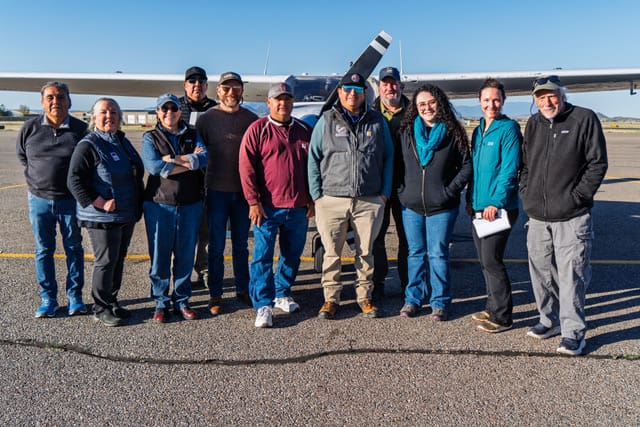
This year, the roster included leaders from Jemez and Tesuque pueblos, a Santa Fe County commissioner, staff from Senator Heinrich’s office, New Mexico Wild, Trout Unlimited, San Miguel del Bado Land Grant and the Upper Pecos Watershed Association, plus an independent journalist.
The three flights occurred in late April and focused on the current drought conditions, areas designated under the Roadless Rule, areas identified for exploratory drilling by Comexico, and the proposed Thompson Peak Wilderness.
With the skilled low altitude flying of our pilot, Chris Benson, as we crossed north of Galisteo Basin and south of Glorieta Baldy, we could see how dry the Galisteo Basin drainage was. We flew over the Village of Pecos and could see the ribbon of green bosque and a strip of river threading through the valley. We ascended the Pecos Canyon and noted the thousands of acres of roadless areas that will be affected by the proposed federal rescission. The current protections afforded by the 2001 Inventoried Roadless Rule, an important building block in the preservation of wilderness and watershed, cover 155,000 acres of the Santa Fe National Forest with half that acreage being forest adjacent to the Pecos Wilderness and the Santa Fe Watershed. The Trump administration is bent on eliminating that rule and allowing road construction for mining and timber extraction.
As we flew over the former Tererro mine, our pilot pointed out a grey earthen strip that contained millions of tons of tailings left behind by mining for lead, copper and zinc in the early twentieth century, a legacy sure to be repeated should mining be allowed again in the Pecos.
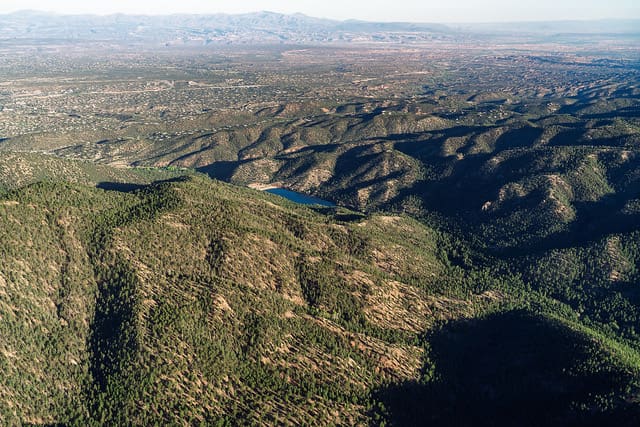
The extreme drought conditions of the Pecos wilderness, with little snowpack, lakes below normal, and reservoirs at fifty percent capacity were obvious during our flight. We were surprised to see the miles of dead spruce forest called “spruce rust”, a slow death of the tree line between 9,000 and 11,000 feet that extends all the way to the Colorado border, which added to our impression of a forest under peril.
As we flew toward Santa Fe Baldy, our guide pointed out the ten-mile stretch of the Thompson Peak Wilderness as proposed in the Pecos Watershed Protection Act (Senate Bill 1319 and House Bill 2727). These bills, introduced by our New Mexico congressional delegation, also include safeguards regarding hard rock mining in the Pecos. If passed, they would help protect the Santa Fe and Upper Pecos watershed from the impacts of exploration and mining like the plans from Comexico to conduct exploratory drilling on a large swath of mountain extending from Indian Creek to Glorieta Baldy.
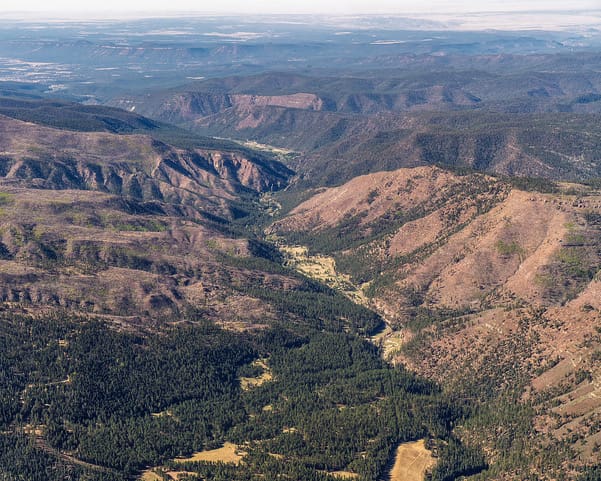
We also saw the vast amount of forest lost to recent fires like the Viveash Fire (29,000 acres in 2000), the Borrego Fire (12,000 acres in 2002), the Tres Lagunas Fire (10,000 acres in 2013), and the Hermit Peak Fire (10,000 to 20,000 in 2022). It looked like half our mountain had burned. It was sad. However, while brown patches of burn area stood out, the vast expanse of the forest was still majestic to behold, a green alpine island in the midst of a large grey desert.
Aside from the thrill of flying above twelve thousand-foot peaks like Santa Fe Baldy and Tesuque Peak, I think the super dry conditions on the lower Sangre de Cristo range left a lasting impression on us.
We thank EcoFlight, Upper Pecos Watershed Association, and New Mexico Wild for offering aerial observations as another tool to protect our environment. We encourage our leaders to stand up for our rivers and watersheds and urge the public to get involved with any form of preservation and protection.